

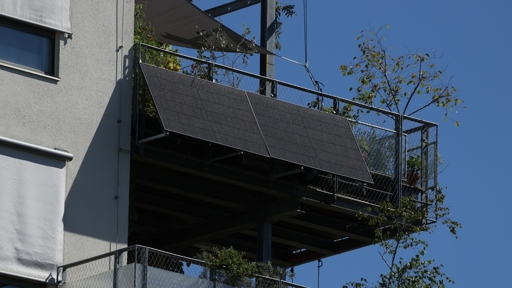
A few weeks ago, the attorney set up what may be the first plug-and-play solar panel in the Bronx. The 220-watt installation, which is secured to the balcony railing with zip ties, has been a boon for the renter and mother of two.
“I have an enormous childcare bill every month. My electricity bills never go anything but up,” Phillips said. “Everywhere you turn, things are only getting more expensive.”
Plug-in solar nonprofit Bright Saver, which provided the roughly $400 panel to Phillips at no cost, estimated that it will produce about 15 percent to 20 percent of the electricity her family uses and save her about $100 per year. Every time Phillips gazes at the device, she said, she’s amazed that “this is just a thing that I plugged in, and I’m generating my own power.”
A) If it’s on a high balcony that people might be passing below, I’d really prefer it to be attached with something a bit more substantial than zip ties… If sun exposure degrades the zip ties and then a sudden breeze causes a panel to detach, it could cause pretty serious injury to someone below.
B) There’s also a potential electrical public safety issue here. If the apartment building maintenance crew shuts off power in order to work on the electrical system, is there anything to prevent these panels from backfeeding into the apartment’s electrical system, making some of the wires still live? Likewise, if the power company has to shut off power to do power line maintenance, is there anything that prevents these panels from backfeeding into the power lines when they’re supposed to be disconnected and safe to work on? (Grid power transformers will work in reverse, increasing the (probably) 120V from the solar panels into much more dangerous transmission voltages in the kilovolts. At extremely low amperage, but could still be quite dangerous to unsuspecting linemen.)
C) There’s also a third potential safety issue. Household electrical outlets (and the wiring for them) are only intended to carry 15 or 20 amps, depending on the type. Normally if you exceed that, then a breaker will trip or a fuse will blow, protecting you from overloading the building’s wiring and potentially causing a fire. But if this plug-in solar system is connected on the same circuit as any other outlets, the other outlets in the circuit could potentially draw more than the rated current because they’re drawing some of that current from the solar system, which doesn’t go through the breaker. An electrical load that was just the right amount of ‘too high’, if connected to the same circuit as the solar panels, could potentially draw too much amperage through the wires, causing them to heat up and start a fire without the breakers or fuses being able to protect you. In an apartment building, that’s especially dangerous, as the person who installed the solar isn’t only endangering themselves, but potentially also endangering everyone who lives in the building. (The higher the power output of the solar system, the more dangerous this becomes. A mere 220W system probably isn’t adding enough amperage to seriously exceed the safety margin … probably … but it’s still best not to risk it.)
I’m all for installing your own solar panels, even in an apartment, but please – do it safely!
Attach it with something stronger and more reliable than zip ties. Ensure there’s a system in place to prevent backfeeding in event of a power outage. Ensure that a plug-in solar system is plugged into its own dedicated circuit, not sharing the circuit with anything else.*
*It would be okay to plug multiple plug-in solar systems to the same circuit, as long as the total power output of all the systems combined is less than ~1800W. And even if you exceed that, the worst thing that will happen is that the breaker trips or the fuse blows. Just make sure they’re not sharing the same circuit with any electrical loads.
They use grid tie inverters what won’t deliver power unless there’s already power on the line for exactly that reason. That’s part of the safety regulation
a) There are stainless steel zip ties, which would be perfectly suitable for the task. The article does not specify the type of zipties used. If they used plastic ones, I’d agree with you.
b) No, the microinverters used in balcony solar need to synchronize to the grid’s frequency. If the power is shut off, they cannot synchronize and won’t work. Some older microinverters where retrofitted with additional safety switches but current ones have them included.
c) Yeah, that’s a valid concern, where I live the maximum allowed power you are allowed to feed into the grid is 800 watt, which is okay considering the common electrical installation, though we use 230V. With 120V amperage doubles with the same power, so a sensible limit would probably be diffrent, but I don’t know whats commonly used in america
this is not high tech. You can mount panels outside and have them charge a large battery backup inside. Independent from the apartment circuits. just plugin the high draw devices. 200W panels, $2300, and you can use the power at night.
B) To add to what Cacaocow said, even if the devices themselves didn’t have this function (and I’m not sure all do), it would only ever be an issue for maintenance at the distribution level (last leg from secondary substation to user). Any work upstream of a substation will be fully isolated and grounded first.
This can be an issue for network operators with distribution- connected generation, though.
Question from someone who has only done extremely basic electrical work: if this thing is feeding power in on one circuit, can devices on another circuit use that power? I’d been assuming you’d have to plug it in next to whatever you intend to draw from it.
Yes. Power will flow back to the breaker panel, through one breaker, through the panel, then out through another breaker and into another circuit where it can be used.
Most homes have two opposite phases (split-phase) with each circuit being on one or the other. Until something trips a breaker, everything on one phase is effectively wired together.
*most homes in the US